

What Happens If You Under-Report Online Sales? HMRC Penalties and Real-World Examples
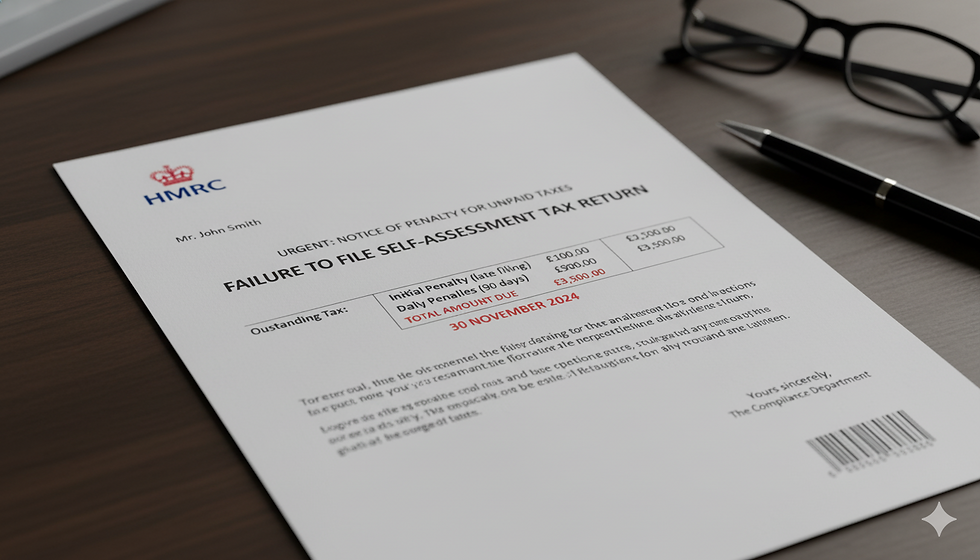
With the "first wave" of platform data from eBay, Vinted, and Etsy now officially in HMRC’s hands as of January 2025, the question for many sellers has shifted from "Will they find out?" to "What happens when they do?"
Under-reporting income isn't always about deliberate evasion—often, it’s a simple misunderstanding of the £1,000 Trading Allowance. However, HMRC’s response depends entirely on why the error happened.
The Cost of Getting it Wrong: HMRC Penalty Tiers
Inaccuracy penalties! HMRC uses a "behavior-based" penalty system. The less "accidental" the under-reporting looks, the higher the fine.

Note: In extreme cases involving offshore accounts, penalties can reach 200% of the tax owed.
Case Examples: 4 Common "Side Hustle" Tax Scenarios
No, if you are simply selling personal belongings occasionally, you generally do not have to pay tax or report income to HMRC. This kind of activity is usually considered casual selling, not taxable trading.
1. The "Nudge Letter" Trap (Accidental Under-Reporting)
Scenario: Sarah sells handmade jewelry on Etsy. In 2024, she made £2,500 in sales. She thought she didn't need to report it because it was "just a hobby."
The Outcome: In early 2025, Sarah receives a "Nudge Letter" from HMRC because Etsy reported her data.
The Consequence: Because she responded within 30 days and it was a first-time mistake, Sarah had to pay the back-tax plus interest (currently ~7.5%) but avoided the heavy 30% "careless" penalty by making a full disclosure.
2. The "Flipping" Failure (Careless Record Keeping)
Scenario: Mark buys trainers to resell on eBay. He turns over £15,000 a year but never registered for Self-Assessment because he "didn't think he made much profit."
The Outcome: HMRC opens a compliance check.4 Mark has no receipts for his original purchases.
The Consequence: Without receipts, HMRC may disallow his expenses and tax him on the full £15,000. He faces a "Prompted Careless" penalty of 30% on top of a large tax bill because he failed to keep business records.
3. The "Ghost Seller" (Deliberate Evasion)
Scenario: James runs a high-volume business on Amazon and Vinted, earning £80,000 a year. He uses multiple bank accounts to try and stay under the radar and deliberately ignores HMRC’s letters.
The Outcome: HMRC uses its "Connect" AI system to link his NI number across multiple platforms.
The Consequence: This is classed as Deliberate and Concealed. James faces a penalty of 100% of the tax owed, potential criminal prosecution, and his name may be published on HMRC's "Deliberate Defaulters" list.
4. Backdated Tax and "Failure to Notify"
HMRC has "discovery powers" that allow them to look back into your past.
4 Years: For innocent mistakes.
6 Years: For "careless" behavior (e.g., not keeping receipts).
20 Years: For deliberate tax evasion. Case Example: Sophie ran a successful Etsy shop for five years without registering. When she finally registered in 2025, HMRC looked back at her 2020-2024 records. She owed £8,000 in back-tax, but with 5 years of compounded interest (currently at a high 7.5% rate) and penalties, her total bill exceeded £13,000. Case Example: Liam sold vintage trainers as a "hobby," making £4,000 in profit. He ignored the nudge letter. HMRC opened a formal enquiry and found his bank was receiving regular "business-like" payments. He was fined 35% of the tax owed because his failure was deemed "prompted" rather than voluntary. He uses multiple bank accounts to try and stay under the radar and deliberately ignores HMRC’s letters.
3 Red Flags That Trigger an HMRC Investigation
Lifestyle Mismatch: Your reported income doesn't match your bank deposits or mortgage applications.
Platform Discrepancies: You report £2,000 in sales, but eBay reports you processed £10,000 in transactions.
The "Hidden Economy" Check: You are registered for a full-time job but have significant activity on "Gig Economy" apps (Uber, Deliveroo) that isn't on your tax return. Important: HMRC can go back 4 years for innocent mistakes, 6 years for carelessness, and 20 years for deliberate tax evasion.
How to Fix an Error Before HMRC Contacts You
If you realise you have under-reported income from previous years, the best course of action is an "Unprompted Disclosure." Telling HMRC before they send you a letter significantly reduces your penalty—often to 0%.
Don't Get Caught Out
We’ll calculate your income, costs, and taxable profit — ready for HMRC. Covering 6 April 2024 – 5 April 2025 ready for the next filing deadline of 31st January 2026.
Why sellers love it;
Simple: One upload, one clear report
Accurate: Matches HMRC tax year and rules
Self Select: You can self-select 'own items' or 'trading items'
Private: You stay in control of your data
Tax Efficient: Calculates all platform sales and uses best methods of lowering tax
Affordable: Only £39 for the full 2024/25 tax year


Comments